
If you’re a food producer serious about shelf life, product quality, or logistics costs, a commercial food freeze dryer is worth understanding properly. Not the countertop version — the industrial kind, built for production volumes, consistent batch output, and products that need to hold their quality long after they leave your facility.
This guide walks through how a food freeze dryer works at a commercial scale, how it performs against other preservation methods, and how to identify the right equipment for your product.
How Freeze Drying Preserves Food
The technical term for freeze drying is lyophilisation. We freeze the product solid, then place it in a vacuum chamber where ice converts directly to vapour through a process called sublimation, with no liquid phase or heat applied to the product during drying.
For food producers, that matters because heat is what degrades the qualities worth preserving. Flavour compounds, natural colour, cellular structure, and nutritional bioactivity all survive the freeze drying process in a way that they simply do not through spray drying or dehydration.
The moisture content drops low enough to inhibit microbial growth, giving you a shelf-stable product with no refrigeration requirement and no added preservatives. And because sublimation leaves behind a honeycomb of cavities where ice once was, the product reconstitutes quickly and faithfully when water is added.
For a closer look at the science, visit our What Is Freeze Drying? Page.

How It Compares to Other Preservation Methods
| Method | Heat Applied | Retains Colour and Flavour | Retains Structure | Shelf-Stable |
|---|---|---|---|---|
| Freeze drying | No | Yes | Yes | Yes |
| Spray drying | Yes (high) | Partially | No | Yes |
| Dehydration | Yes | Partially | No | Yes |
| Air drying | Yes | Low | No | Variable |
Freeze drying is the only method that removes moisture without heat exposure. For producers where end-product quality commands a price premium (food, nutraceuticals, pet food), the preservation method is a commercial decision as much as a technical one. A freeze dried food machine that removes moisture without heat exposure gives you a product that rehydrates close to fresh. Heat-treated alternatives cannot offer the same.
See our Why Freeze Dry? page for the full breakdown.
What Commercial Production Requires from the Machine
A freeze dry food machine at production scale needs consistent batch performance across diverse product loads, precise shelf temperature control through primary and secondary drying, and a refrigeration system engineered for continuous commercial use.
Two specifications anchor every sizing decision:
Ice capacity (kg)
The total moisture the machine removes and condenses per batch. This is the primary measure of throughput capacity.
Shelf area (m²)
The usable loading surface inside the vacuum chamber determines how much product you can run per cycle.
Spec both your product and volume from the start. A machine undersized on either figure will limit your production before anything else in the line does. We cover how to think through both on our applications page.
Matching the Machine to Your Product
General Purpose — GPC Range
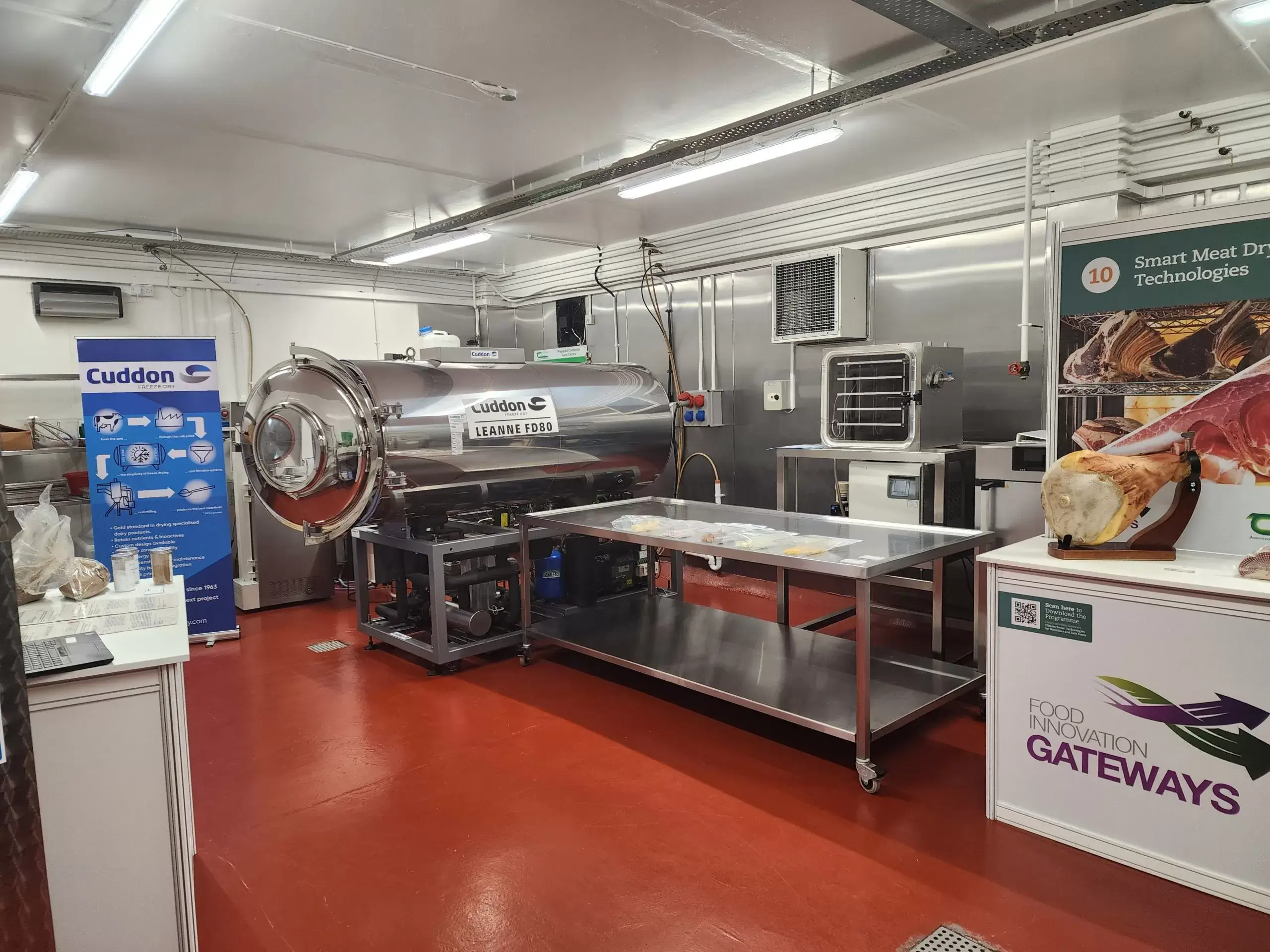
Fruits, vegetables, meats, dairy, ready meals, pet food, and nutraceuticals all process well on a General Purpose freeze dryer. Our GPC range runs on natural CO₂ refrigerant, which keeps operating costs down and reduces environmental footprint compared to conventional refrigerants. Batch capacity runs from the FD600GPC at 600 kg ice capacity up to the FD1800GPC at 1,800 kg, covering early commercial operations through to large-scale production facilities.
High-Sugar and High-Acid Products — LT Range
Mango, citrus, honey, and certain confectionery have a lower eutectic point, which makes them significantly harder to freeze solid cleanly. Our Low-Temperature (LT) range is built for this, with an ice coil operating at a substantially lower temperature to handle what a standard machine cannot process consistently.
Both ranges support multi-product use, so a single machine can move across different product types between cycles. Browse our full product range to see where your product fits.
Why Cuddon Freeze Dry
We have been engineering and manufacturing commercial food freeze dryers in New Zealand since 1963. Every machine is designed, fabricated, and tested in-house under ISO 9001 certification — a quality management standard that gives clients consistent, verifiable production quality across every unit we deliver.
Our freeze dryers have been in documented commercial operation for close to 40 years, and we back every machine with a fully turnkey service: consult on your product, design to your requirements, build, install, commission, train your team, and provide ongoing after-sales support. Our sales and service network spans Oceania, the USA, Canada, and Europe.
There are no third-party installers, no reseller between the manufacturer and the buyer. When you have a question or a problem, you’re talking to the people who built the machine.
Let’s Talk About Your Product
If you’re scoping a commercial food freeze dryer for your operation from early feasibility through to final specification, get in touch to discuss your product and production requirements with our team directly.